Archive

Posts Tagged ‘Cholesterol’

Forget Cholesterol – Think Heart “Inflammation”

July 13th, 2010

If you listen to all the Lipitor drug ads, fighting cholesterol is all it takes to fight heart disease. “NOT SO” say the most learned minds on the subject.

According to all of the latest research, the real danger it turns out is inflammation in the form of two frightening compounds found in the blood of heart attack victims:

  • Homocysteine
  • C-Reactive Protein

And you don’t get these compounds from certain foods – your body makes them in response to other substances.

Why don’t doctors know about all this? If they do, why aren’t they telling us?

And you don’t need a drug to control Homocysteine and C-Reactive Protein.

Checking your Cholesterol is so Last Century!

For much of the 20th century, doctors and patients tracked the ups and downs of cholesterol levels to determine the risk of having a heart attack. But the evidence supporting the link between high cholesterol and heart disease has been, from the start, pretty flimsy. Certainly, people with extremely high cholesterol levels or familial hypercholesterolemia do have a higher risk of heart disease. But elevated cholesterol levels appear to be more of a symptom than a cause – a sign that something, somewhere is awry.


In the late 1990s, researchers at the Harvard Medical School were on the trail of a new, and more likely, factor in coronary artery disease (CAD). Paul Ridker, MD, and his colleagues suspected that “inflammation” was a key player in heart disease. They developed a test for “high sensitivity C-reactive protein” (CRP) that was able to detect chronic low-grade inflammation, something missed by all other medical tests.

Lipitor-Statin Drug Madness

In the 1990s, to hoodwink the public at large, drug companies introduced cholesterol-lowering statin drugs, such as Lipitor, practically cementing the largely unsubstantiated link between cholesterol and heart disease. That began a high-pressure sell to get both consumers and physicians interested in using statins to lower cholesterol levels, and Lipitor alone now accounts for $13 billion in yearly sales.

But nearly everyone seems to ignore a key fact: half of people with heart disease have normal cholesterol levels. So there must be other big risk factors, but what are they? C-Reactive Protein and its kissing cousin, Homocysteine.

Read more…

Anti-aging, Heart Health , , ,

Metabolic Cardiology: Rocket Fuel for Your Heart

March 2nd, 2010

February was American Heart Month but we think this subject is so vital that we are carrying it over to March.

Heart Disease remains America’s #1 Killer, and no matter how many fancy drugs Big Pharma throws at the problem, it keeps getting worse.

This special interview, with Dr. Stephen Sinata, a Fellow of the American College of Cardiology and former Chief of Cardiology at Manchester Memorial Hospital, just might change what many have always thought about heart health.

More importantly, it could save your life!”

Good Heart Sense: An Interview with Cardiologist Dr. Stephen Sinatra

By Lindsay Wilson, Nutrition Reporter
Natural Grocers by Vitamin Cottage

Lindsay Wilson: You are a board certified cardiologist, but your approach to cardiovascular health is not entirely conventional. You practice something you call “metabolic cardiology.” Can you explain what that is?

About Dr. Sinatra
Stephen Sinatra, M.D. is a Fellow of the American College of Cardiology and former Chief of Cardiology at Manchester Memorial Hospital where he has been Director of Medical education for the last ten years.
 
Dr. Sinatra is also an Assistant Clinical Professor of Medicine at the University of Connecticut School of Medicine. His New England Heart & Longevity Center in Manchester, Conn., integrates conventional medical treatments for heart disease with complementary nutritional, anti-aging and psychological therapies that help heal the heart.
 
Dr. Sinatra is also the author of several books including Optimum Health, Heart Sense for Women and The Sinatra Solution: Metabolic Cardiology.

Dr. Stephen Sinatra: Metabolic cardiology describes the biochemical interventions used to improve energy metabolism in the heart. The heart uses a large amount of energy, in the form of adenosine triphosphate (ATP), to function. The body is continuously making ATP, but when people have any form of heart disease — whether it’s a diabetic heart, an alcoholic heart, someone who has had a bypass or a heart attack or even an otherwise healthy person with hypertension, any sick heart — their hearts’ cells are losing ATP and overtime, the body can’t make it fast enough to refill the tank. What metabolic cardiology is all about is preserving the heart’s cells with the substrates it needs to make ATP. If you give it what it needs CoQ10, L-carnitine, D-ribose and magnesium — the heart has an incredible innate intelligence to repair itself. When you give it the right nutraceutical support, the heart’s energy machinery, the mitochondria, can produce more ATP. The heart needs ATP for systole and diastole (contraction and relaxation) but the heart also needs ATP to repair and rejuvenate itself. When you give a cell ATP, the cell is able to repair itself.

When you increase ATP to any cell, you’re increasing the pulsatile activity of the cell, allowing the cell to function better, allowing more nutrients in, more toxins out. When you do that, you really invigorate, regenerate and revitalize the cell — that’s what metabolic cardiology is all about.
Read more…

Heart Health , ,

Are You a Heart Attack Waiting to Happen?

February 23rd, 2010

If your systolic blood pressure reading is continually above 120, you are a ticking bomb, just waiting for a heart attack to happen!

February is National Heart Awareness Month and for good reason. Heart Disease is America’s #1 Killer. There are over one million unnecessary deaths each year from strokes, heart attacks, cardiac arrest, severe angina and clogged arteries.

Yet it shouldn’t be this way.

Did you hear about what happened to former President Bill Clinton last week? He required emergency surgery to have two stents placed in one of his coronary arteries due to chest pains – this after having quadruple bypass surgery in 2004.

Over two-thirds of Americans suffer from some kind of cardiovascular disease; heart attacks, strokes, clogged-up arteries, dangerously high cholesterol and homocysteine, hypertension, high blood pressure and diabetes. It is estimated by medical researchers that in excess of one million people die each year from heart related problems, and all unnecessarily.

Obesity is also a chronic problem in all age groups and getting worse by the second. The first lady, Michelle Obama, last week launched an initiative to fight Childhood Obesity.

Conquering what I call the Foot and Mouth Disease; a lack of exercise (foot) and eating too much food (mouth) – has an immediate impact in reversing both of these epidemics.
Read more…

Heart Health , , , ,

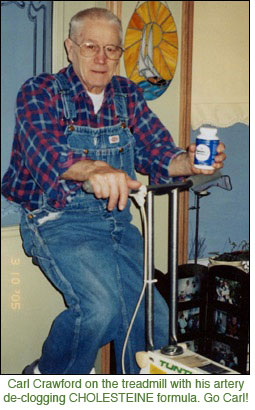
How Carl Bypassed a Bypass

February 19th, 2010

Carl Crawford - Saved from Triple Bypass Surgery

“My husband Carl had 100% blockage in two main arteries and the other was 60% blocked!”

Carl started to have chest pains when working in the yard or out in the cold and he was very tired all the time. The doctor ordered a heart catheterization and found that all three arteries had clogged up, two were 100% totally clogged, and the other had over 60% blockage. Carl’s cholesterol level was over 600. (no, this is not a misprint) and his triglycerides were 1,233! (again, not a misprint.)

Carl had a triple by-pass operation 13 years ago and wasn’t about to go through it all over again, as the pain nearly killed him the first time. So, the doctor put a stent into the one artery with only 60% blockage and said that was all he could do for Carl.

We were both desperate to do something more. That’s when it hit me – call Wayne Garland. He had done so much for us and others over the years with his formulas.

I dug up his number and called him out of the blue. He said he had a program for Carl that would de-clog his arteries, get his cholesterol down and also shed the pounds of extra weight, so his heart would work easier. And get this, with NO DRUGS OR SURGERY!
Read more…

Heart Health , , , ,

Double-Breakthrough Defeats #1 Silent Killer‏

December 15th, 2009

Last week we uncovered the mystery of why Heart Attacks Spike at Christmas, but did you know High Blood Pressure is the biggest and most dangerous epidemic in the world?

Nearly 1 Billion people have it, leading to millions of deaths from heart disease, strokes and kidney failure. It affects every country on the planet and is getting worse by the second.

The most alarming thing is the fact that it is a “SILENT KILLER”.  99% of people have no idea that their blood pressure is high and setting up a fatal heart attack or stroke.

Drugs are not the answer, they only “hide” the problem, they do not solve it.  But Mother Nature can!”

Blood Pressure Rising Around the Globe

The numbers are a shock: Almost 1 Billion people worldwide have high blood pressure, and over half a billion more will harbor this silent killer by 2025.

It’s not just a problem for the ever-fattening, obese Western world. Even in parts of Africa, high blood pressure is becoming common. That translates into millions of deaths from heart disease alone.


Read more…

Blood Pressure, Clogged Arteries, Heart Health , , ,

*Statements made on this site have not been evaluated by the FDA. These products are not intended to diagnose, treat, cure, or prevent any disease.

The information provided on this site is for informational purposes only and is not intended as a substitute for advice from your physician or other health care professional or any information contained on or in any product label or packaging. You should not use the information on this site for diagnosis or treatment of any health problem or for prescription of any medication or other treatment. You should consult with a healthcare professional before starting any diet, exercise or supplementation program, before taking any medication, or if you have or suspect you might have a health problem. You should not stop taking any medication without first consulting your physician.